Matheus Leite

SELL THE INSURANCE. DON’T BREAK THE CREDIT.
How a four-week LAB experiment tested insurance inside Cofidis’s credit application and payment app.
01. THE SITUATIONCofidis is a consumer credit company in Portugal with around 1 million customers. In 2022 it wanted to grow its “diversification” insurance range (home, health, pets, travel and electronics), sold on its own rather than as protection for a loan. The company saw it as a second business model next to credit, and asked the LAB, its experimentation team, to test how that insurance could be embedded in the core business.
The starting bet was simple: a credit request already says what someone is about to buy, whether a car, a trip or a new sofa. That makes it the right moment, with the right information, to offer the insurance that fits, instead of selling it through separate channels.
EVERY LOAN HAS A PURPOSE. EVERY PURPOSE HAS A RISK.
What “embedded” means here:
Embedded insurance is offered inside another purchase, at the moment it happens, instead of being sold on its own. Think of travel insurance offered while you book a flight.
02. THE CHALLENGE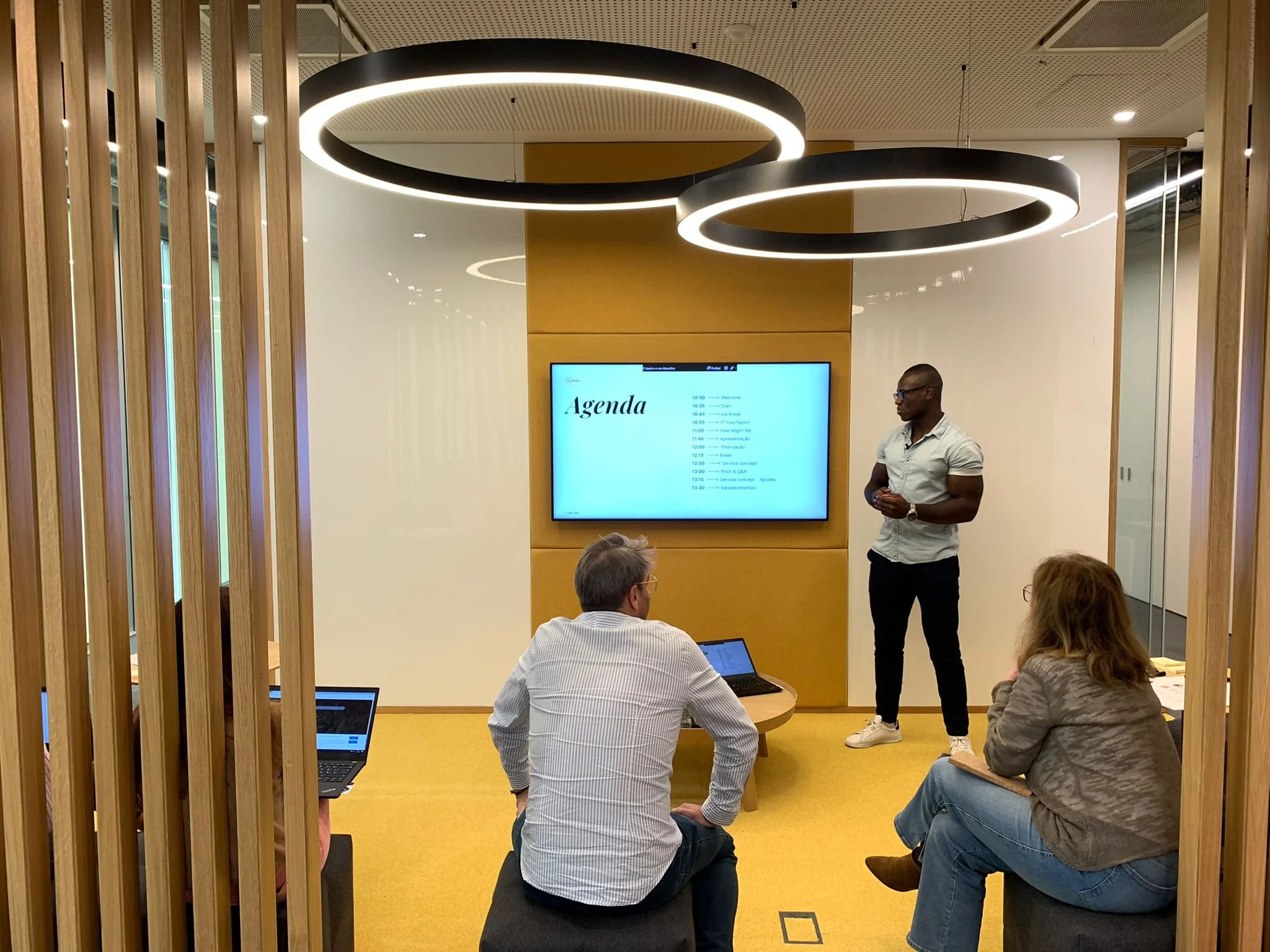
NO BLANK PAGE.
FOUR WEEKS to get the balance right.
The insurance had to sit inside the credit application in a way that got people to sign up, without slowing down or putting at risk the credit sale that pays the bills.
The opposite risk was just as real: pushing so hard that business value overtook what the customer needed. People already distrusted insurers, and an offer that felt like a trap at checkout would hurt both products.
Most LAB experiments tested new business models outside Cofidis’s core, starting from zero. This one had to live inside the core, which meant less inventing and more negotiating space in someone else’s product.
03. THE JOURNEYDISCOVERY
What people fear when they buy insurance, and what that meant for the design.
DELIVERY
Two experiments: an offer inside the credit request, and a push after purchase.
OUTCOME
The numbers, the lessons and where it stands today.
DISCOVERYLISTEN FOR THE FEAR. THEN DESIGN AGAINST IT.
INTERVIEWS: Speed was the brief. Trust was the problem.
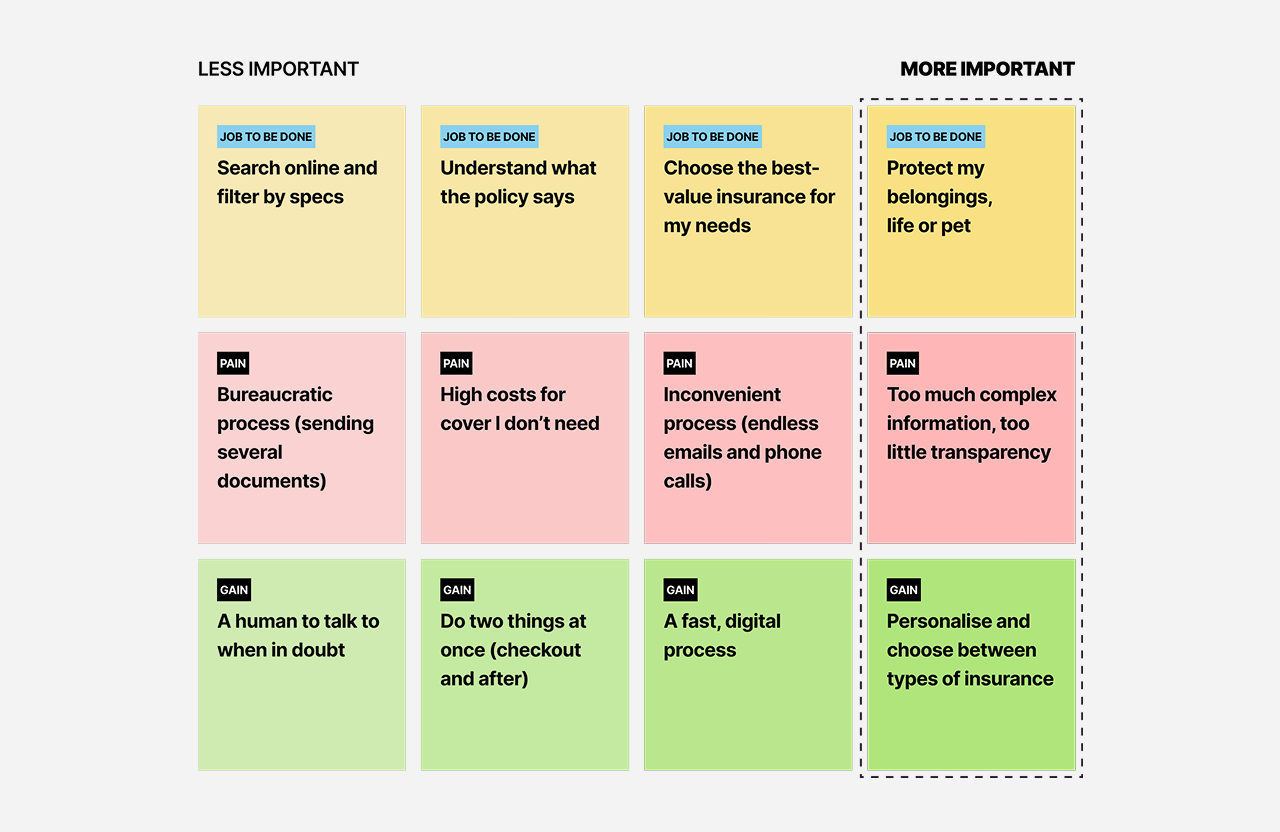
The brief framed insurance as a convenience problem: too many emails, calls and documents before you get a policy. Seven interviews confirmed that friction, then went past it. Underneath sat distrust. People were wary of the small print and afraid of paying for cover they would never use, and a faster form doesn’t fix either.
“The unknown brings a bit of suspicion. What if I don’t read the small print?”
Protect what matters. Make it clear. Let me choose.
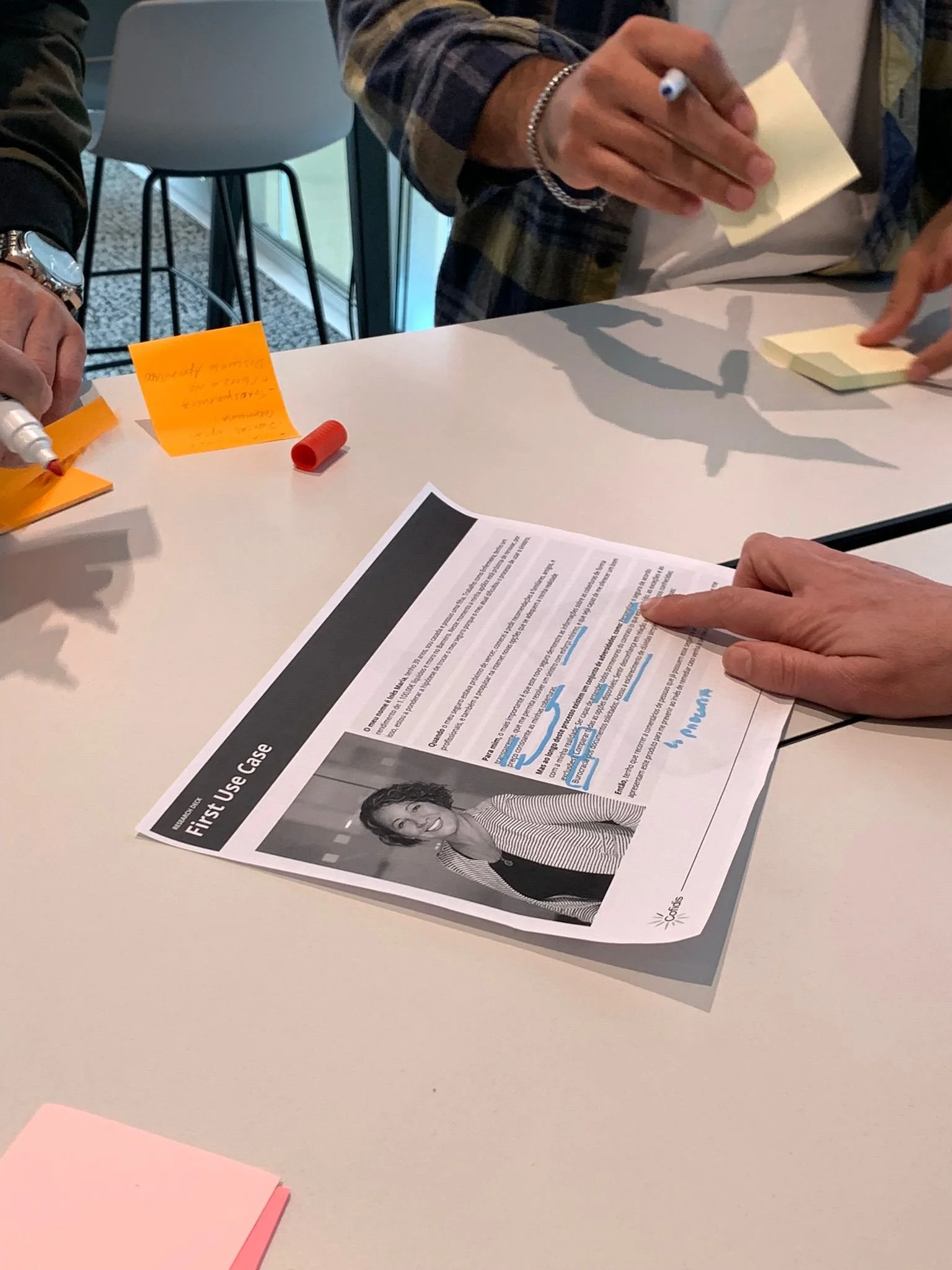
PERSONA: Inês Maria, 39, an accountant from Barreiro with a car loan through Cofidis, believes it’s better to be safe than sorry. She would buy insurance. What she wouldn’t do is pay for something she couldn’t explain. Her line became the test for every screen: “The most important thing is to feel safe with my choice and avoid paying for what I don’t need.”
FIVE TOUCHPOINTS: The map follows a customer from the credit request to the policy in hand, and records what they need, what would make it better and what makes them give up at each step.
Acquisition. People want cover offered with the purchase, matched to what they’re buying. The alternative, looking for insurance after the fact, is effort most people never make.
Customization. They want a fair price and cover explained simply, choosing only what they need. The pain is a policy that costs too much because of cover they’ll never use.
Documentation. They want paperwork without effort, ideally reusing the data Cofidis already holds. Instead, the process is effort and hassle.
Signature. They want a fast, secure signature and a clear view of what is and isn’t covered. Today the information is so complex that many rely on family or friends to understand it.
Policy issue. They want the policy the moment they sign, kept in their Cofidis account. The pain is waiting too long for it to arrive.
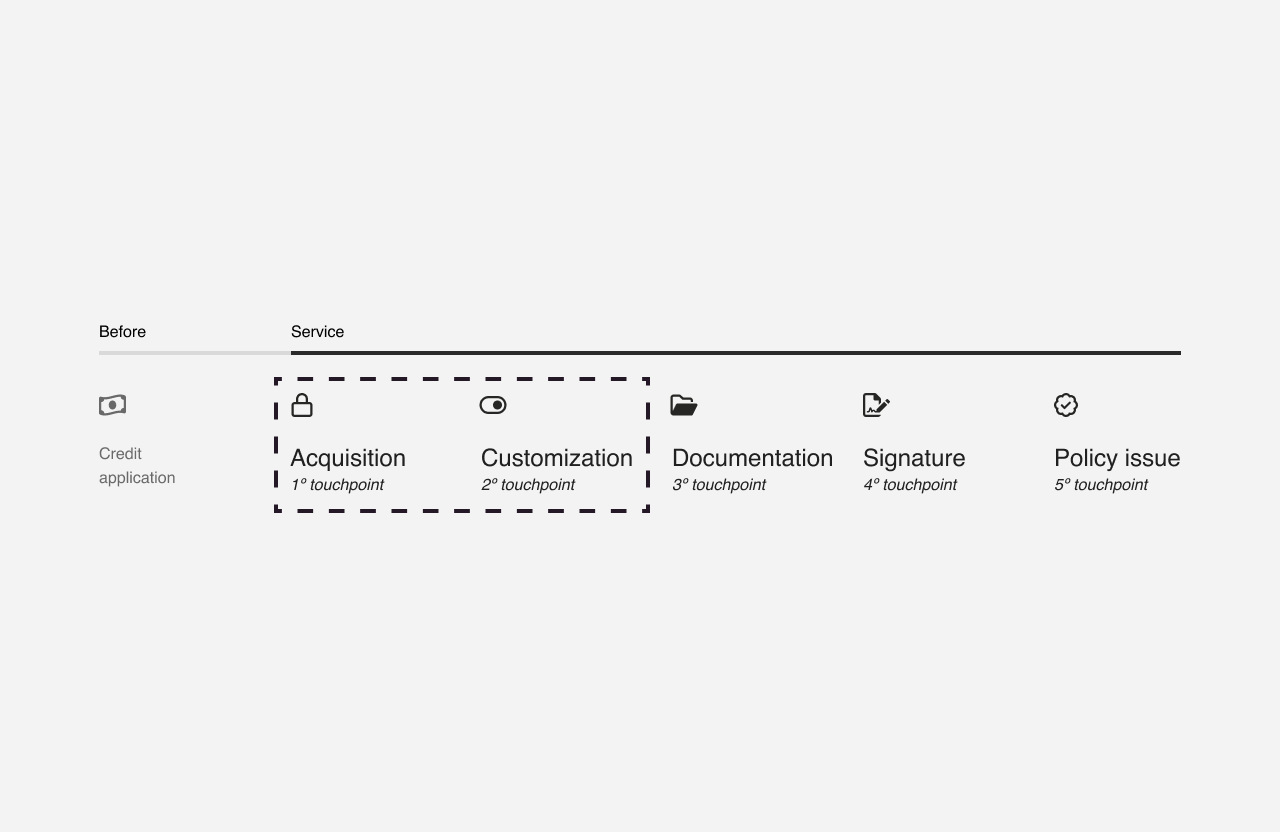
Five touchpoints, one owner: Cofidis, from the first offer to the policy in hand.
We focused the experiment on the first two touchpoints, because that’s where the offer is accepted or ignored. Acquisition became the offer matched to the purpose of the loan; customization became the policy the customer builds, with a slider and a toggle for each cover. If nobody says yes at checkout, nothing that comes after matters.
Qualitative synthesis of 7 semi-structured interviews, organised with the Value Proposition Canvas (jobs, pains and gains). Each card groups recurring statements from different interviews into one theme; only the four strongest themes per category are shown. Position reflects my reading of each theme’s relative weight across the interviews, considering how consistently it came up and how strongly people expressed it, not a count. It is directional evidence from a small sample, not a statistically representative ranking.
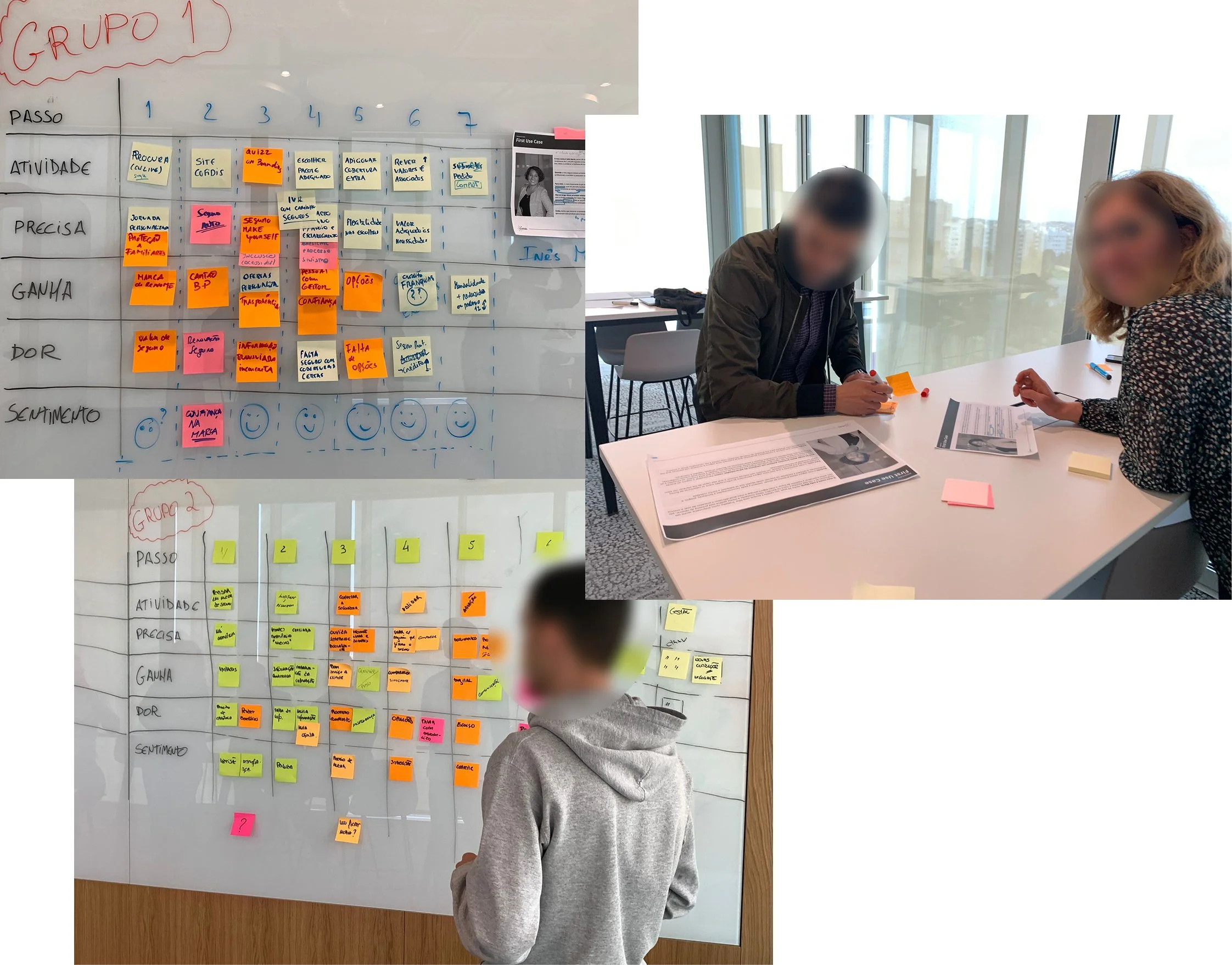
In the workshop, business teams worked in groups with Inês Maria’s profile printed in front of them. Each group walked her through buying insurance step by step, filling six rows for every step: what she does, what she needs, what she gains, what hurts and how she feels. One group mapped seven steps and the other eight. Their maps differed in length and wording but agreed on where the friction was, and that overlap became the five touchpoints.
Documentation, signature and policy issue were left out of the experiment by choice of strategy and scope. They would become a real concern in a rollout, where the promise of a simple offer has to hold all the way to the policy in hand.
DELIVERY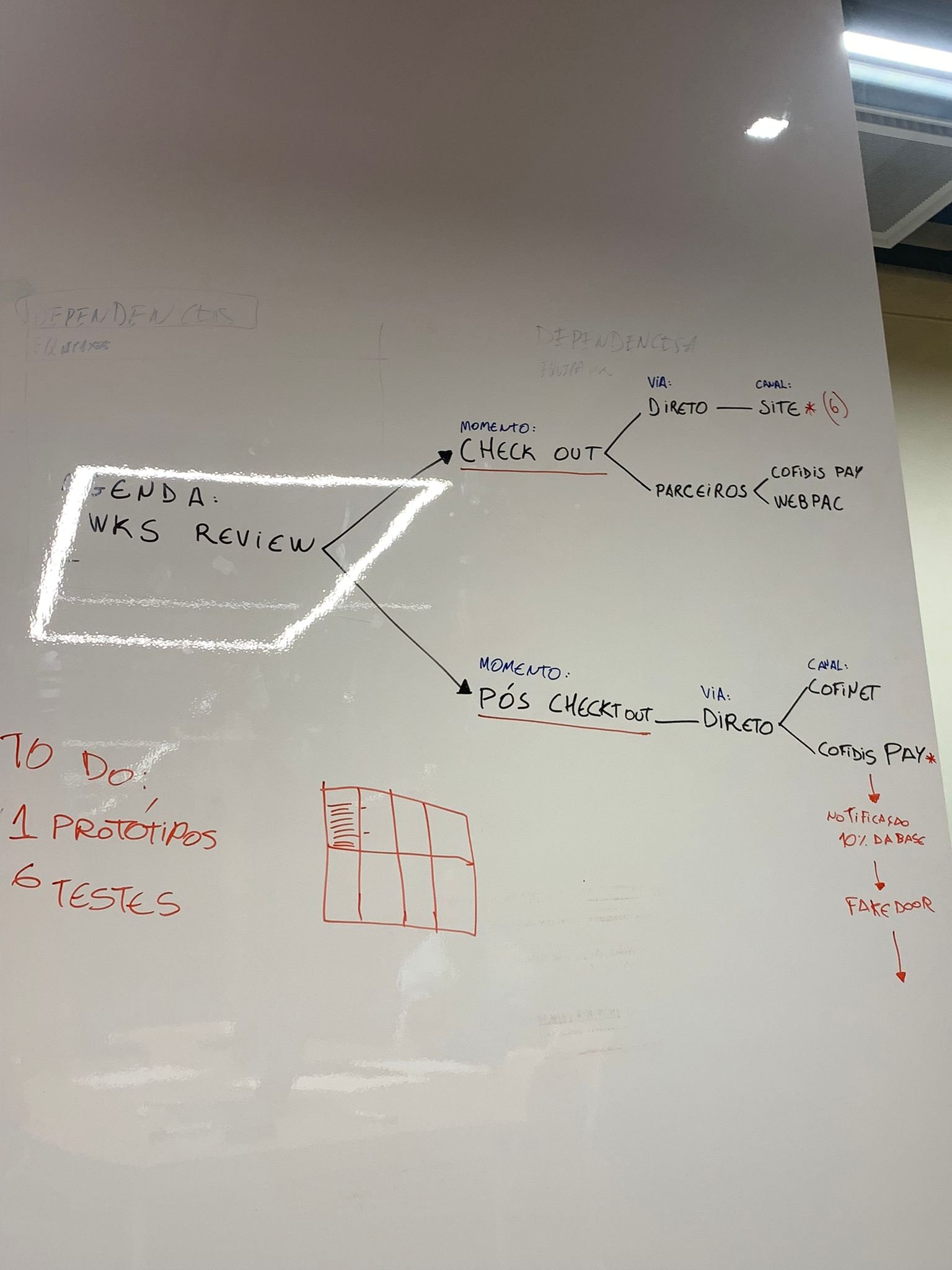
TWO MOMENTS. TWO EXPERIMENTS.
Discovery told us what to design. Delivery tested where it belonged: during the credit request, and after a purchase.
Where the two experiments were chosen, one branch for checkout and one for after it.
WORKSHOP
Co-authors, not gatekeepers.
The credit website and Cofidis Pay weren’t ours to change. Rather than design in the LAB and ask for permission later, I brought their teams into an ideation workshop from the start. Each group sketched its own version of insurance inside credit: a furniture loan, a car loan, a phone bought with Cofidis Pay. Ideas they had drawn themselves were easier to say yes to, and that is what later got us a prototype inside their flow and a push to their users.
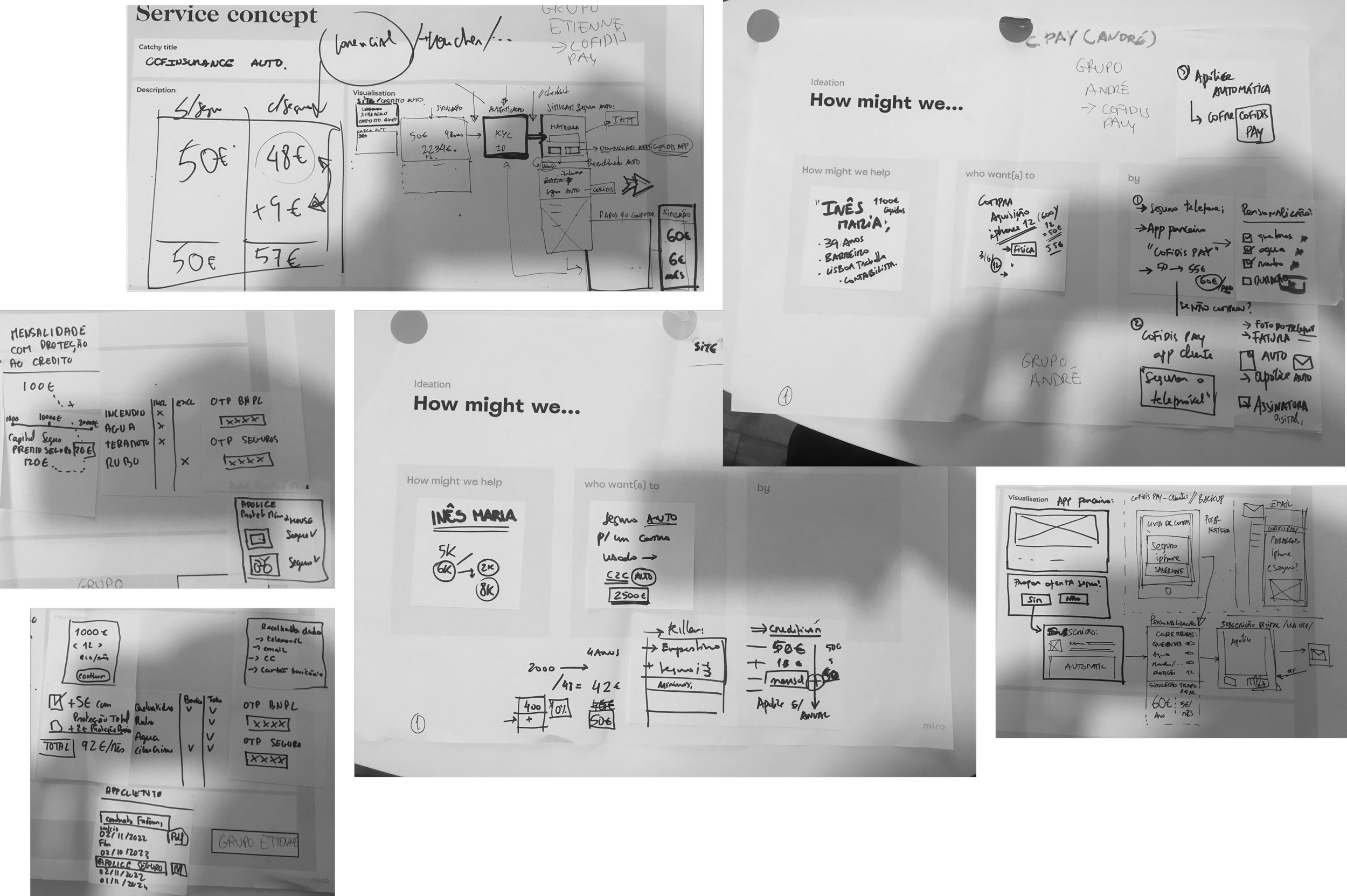
One monthly payment for credit and insurance, 50 € becoming 57 €, was first drawn here by the business teams.
EXPERIMENT A: CHECKOUT
THE OFFER: Let the loan decide how much to show.
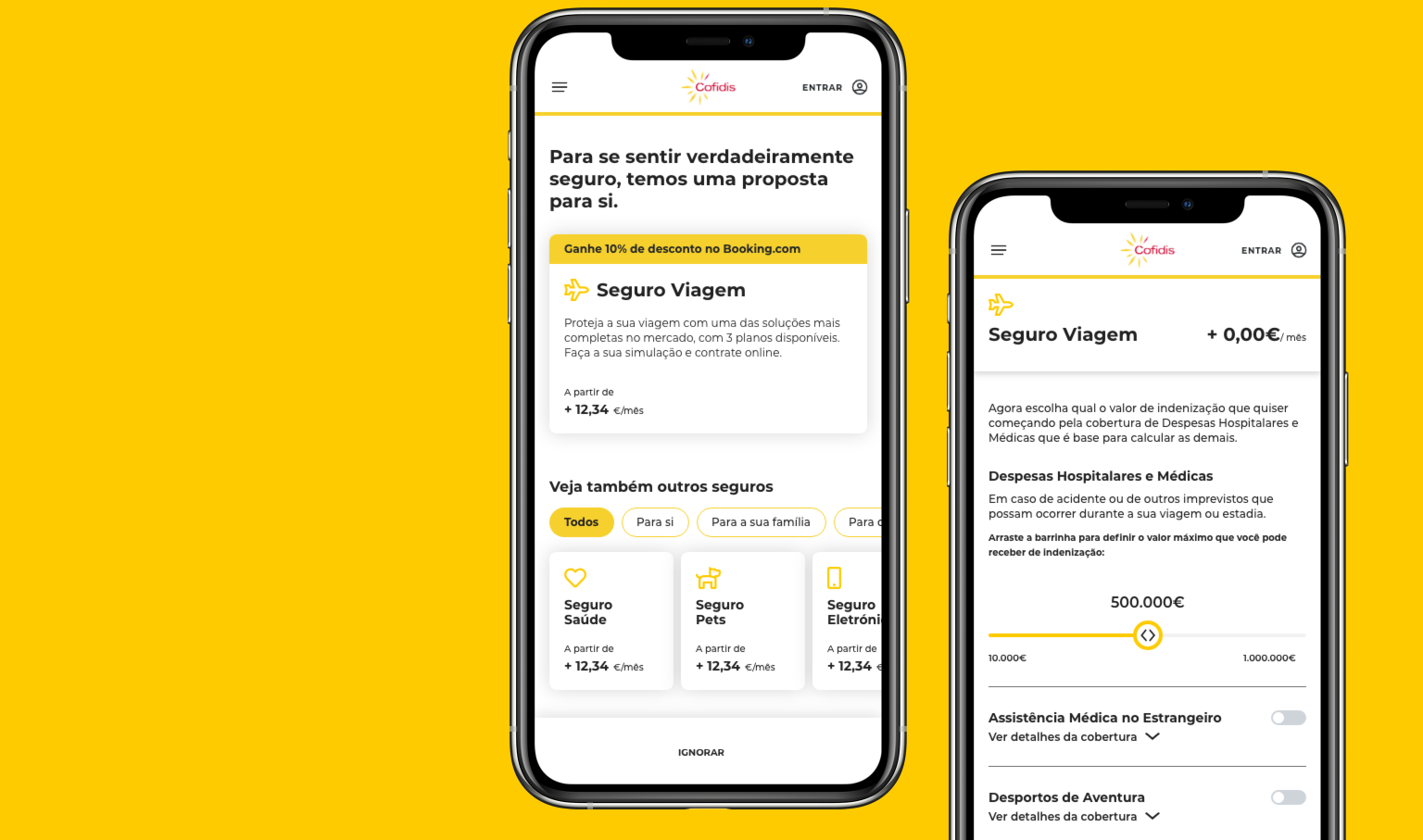
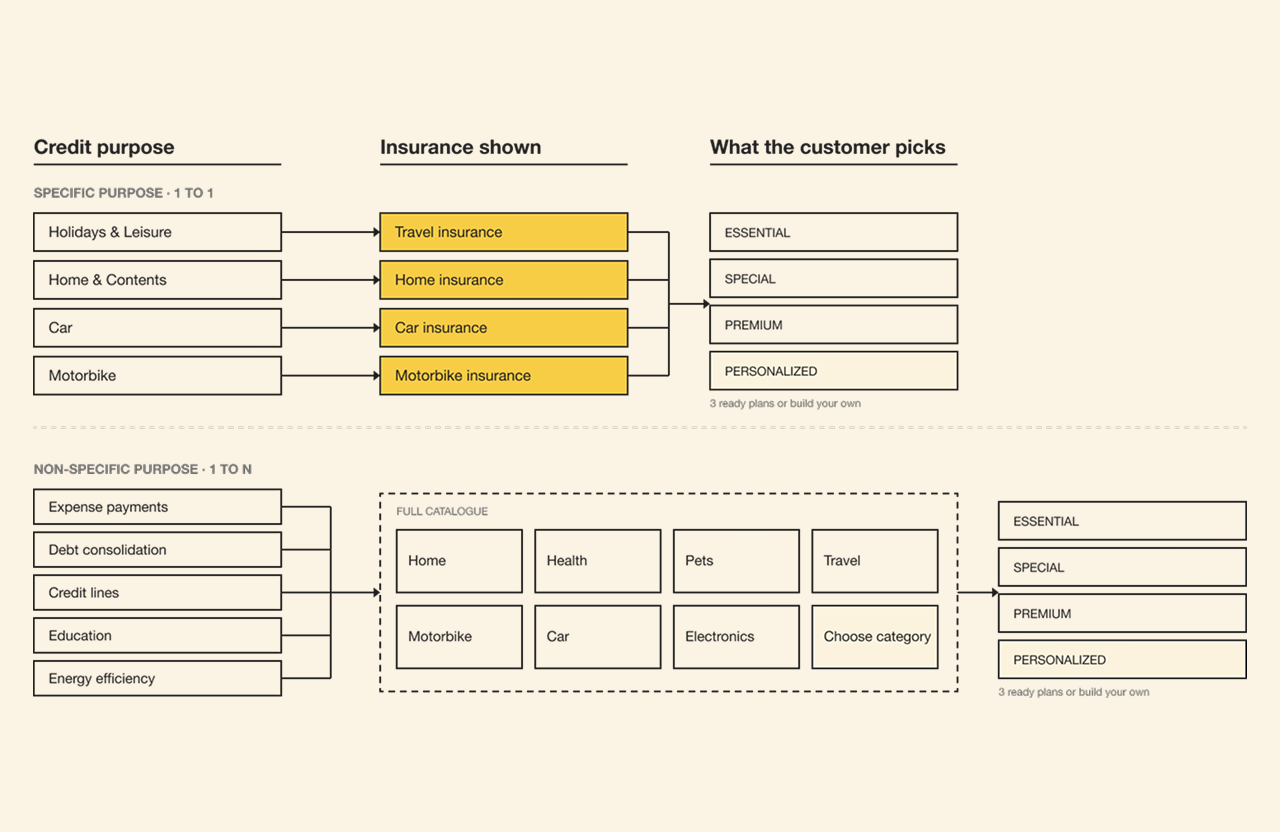
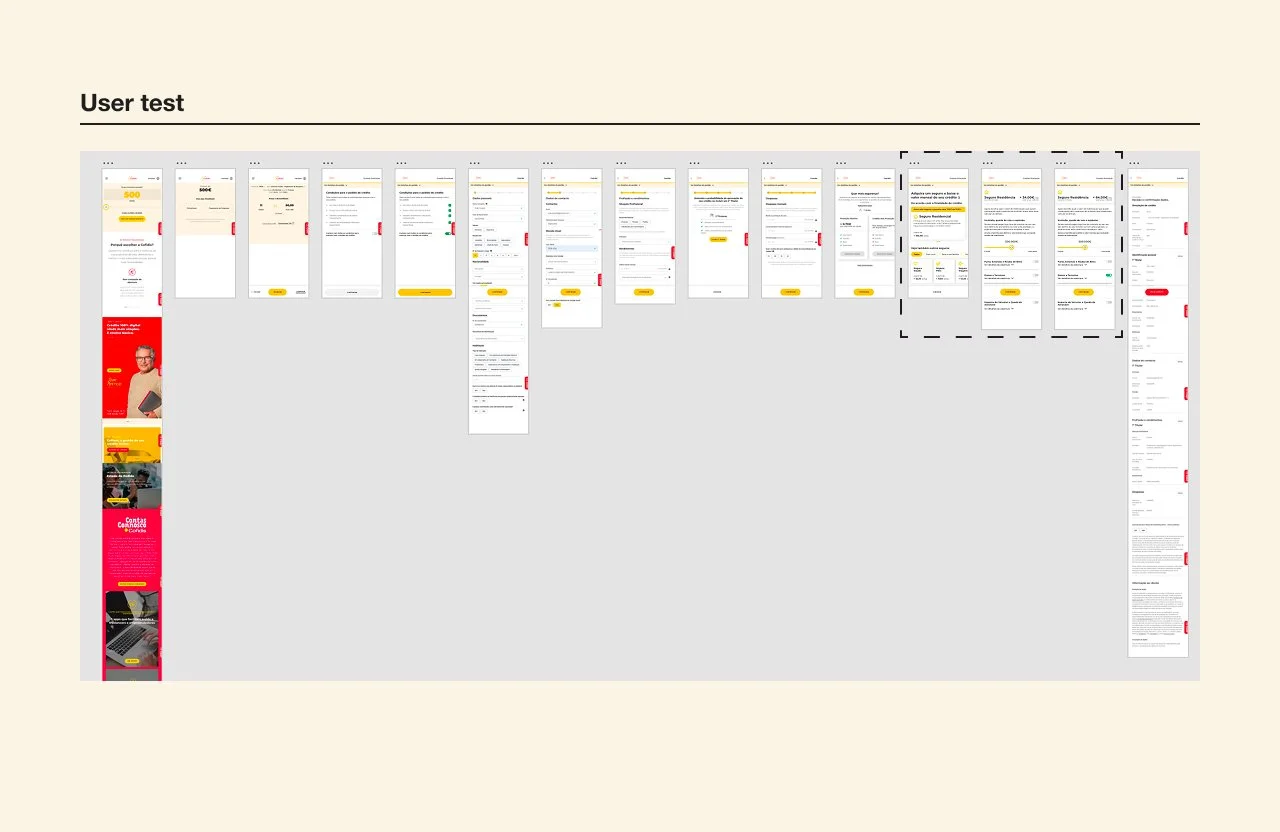
When the credit request named its purpose, showing every insurance would have been noise. A holiday loan only needs travel insurance, so I showed one product in three ready plans, plus the option to build your own. When the purpose was vague, like debt consolidation or paying expenses, guessing would have been worse than asking, so the customer saw the full catalogue and chose. Either way, credit and insurance shared one screen and one monthly payment, so adding cover felt like adjusting the loan, not signing a second contract. To make the bundle worth it, I designed two incentives: a lower credit rate, or a partner discount.
Behind: the old account menu, five links. In front: the new menu, one way into the profile.
A clear purpose narrows the offer to one product. An open one opens the catalogue.
The loan changes where the customer starts, never how much they can choose.
THE TEST:
Three answers, one open question.
We put the prototype in front of people in five in-person sessions. Three hypotheses held: people simulated insurance during the credit request without being pushed, accepted one monthly payment for both, and valued offers that met the purpose of their loan. The fourth, that clearer contract information would mean fewer calls to customer service, stayed open, because a prototype can't count real calls.
Legal set the boundaries for anything that came next: a promotional rate for bundling was allowed, and the insurer, not Cofidis, would always decide on claims, even if Cofidis ran the entire experience.
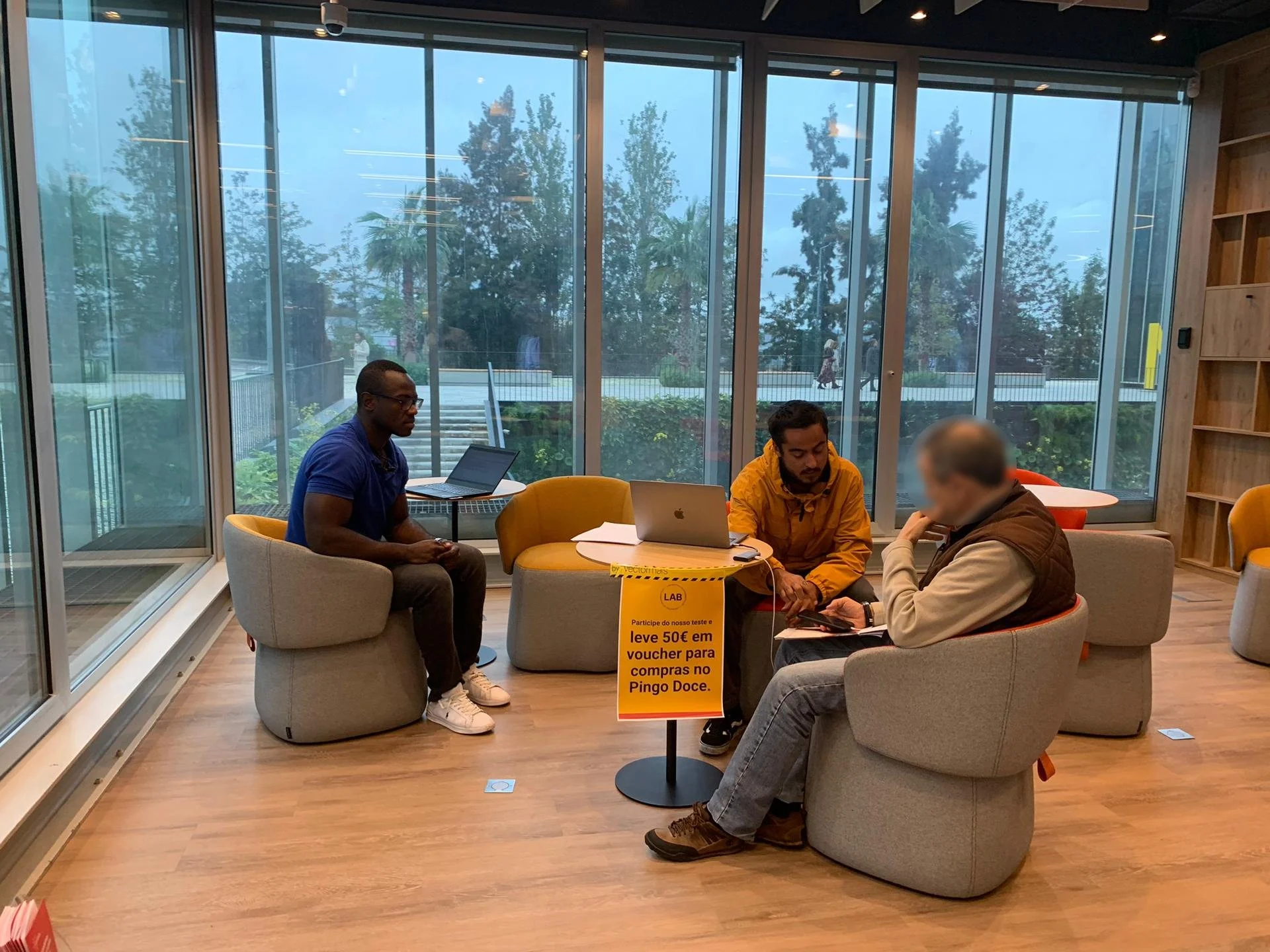
How we recruited, LAB style: No panel and no recruitment agency. We went down to the Cofidis store below the office, set up a table and a sign offering a 50 € grocery voucher, and spent the whole day testing with whoever walked in, customers and future customers alike. It was cheap, fast and as close to the real moment as a prototype could get.
EXPERIMENT B: AFTER PURCHASE
ASK BEFORE YOU BUILD.
Test the demand, not the product.
Every cohort followed the same path: customers who had paid for a purchase with Cofidis Pay in one specific category in the last six months, and then downloaded the app and created an account. Each category was mapped to the insurance that would protect that purchase: DIY and furniture to home, dental and aesthetics to dental, sports and optics to health, tech and training to electronics, motorbikes to motorbike, and car workshops to car. Getting there was the slow part. The segments had to be pulled from Cofidis Pay’s purchase data, the push had to fit the app team’s communication rules, and the message had to clear compliance, all in a two-day window. The test was small. The coordination behind it wasn’t.
I wanted the survey to stay quiet about the insurance not existing yet. A cleaner fake door, one that only reveals itself after people show real intent, would have told us much more. But an earlier LAB experiment had done exactly that without clearing it with legal first, and legal pushed back hard. After that, telling people upfront was non-negotiable. It made the test more honest and less precise, and that trade-off is part of why the last step stayed unreadable.
After a purchase, the question changed. Would someone who had just paid with Cofidis Pay want to protect what they bought? There was no product to sell yet, and building one only to find out would have defeated the point of the LAB. So we built a fake door instead of a house. A push notification went to six cohorts of Cofidis Pay customers, each built around a recent purchase. Tapping it opened a one-question survey that said, upfront, that the insurance wasn’t available yet and asked how likely they were to buy it.
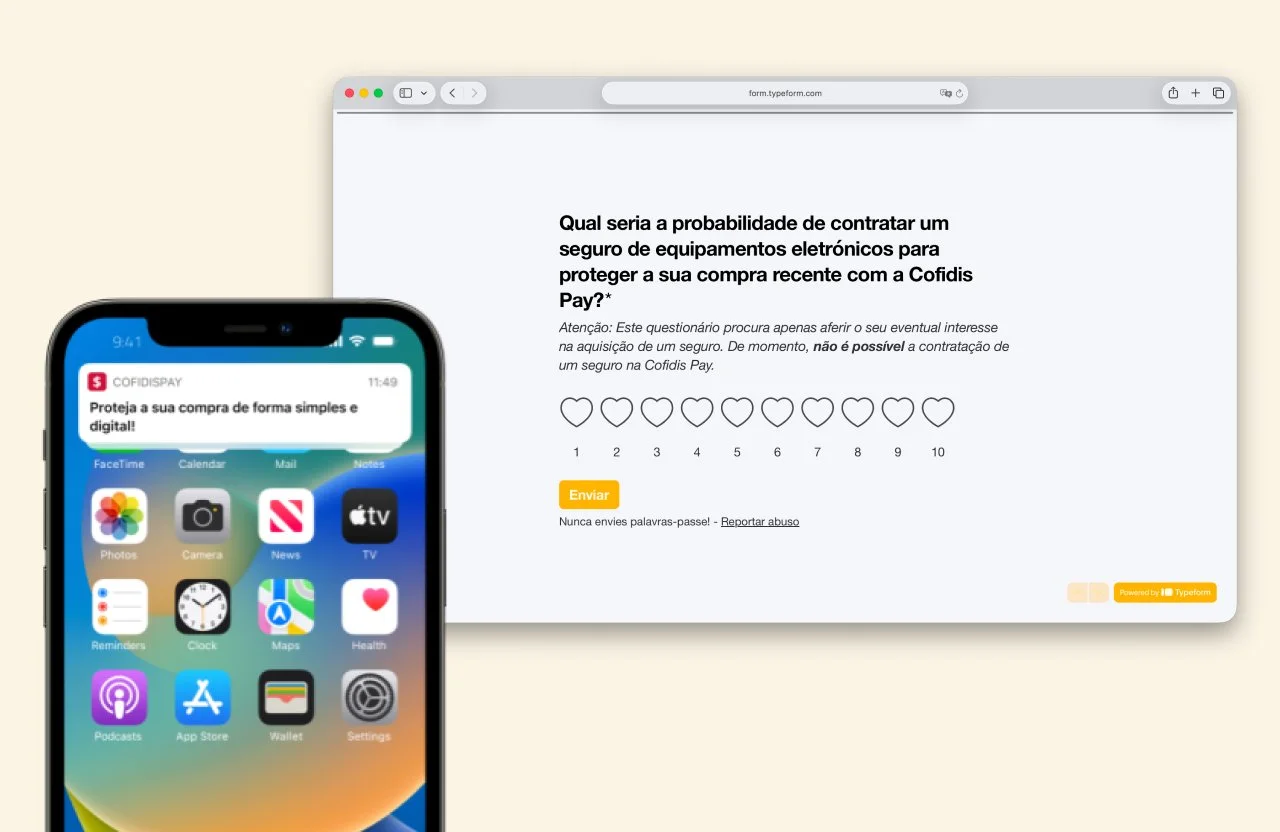
The push borrowed the interviews’ own words: simple and digital.
Before sending anything, we set two thresholds: at least 15% of people opening the app from the push, and at least 4.95% of those reaching the survey. Anything below that and the idea would stop there. The funnel tracked every step, from notification delivered to answer submitted, cohort by cohort, over two days.
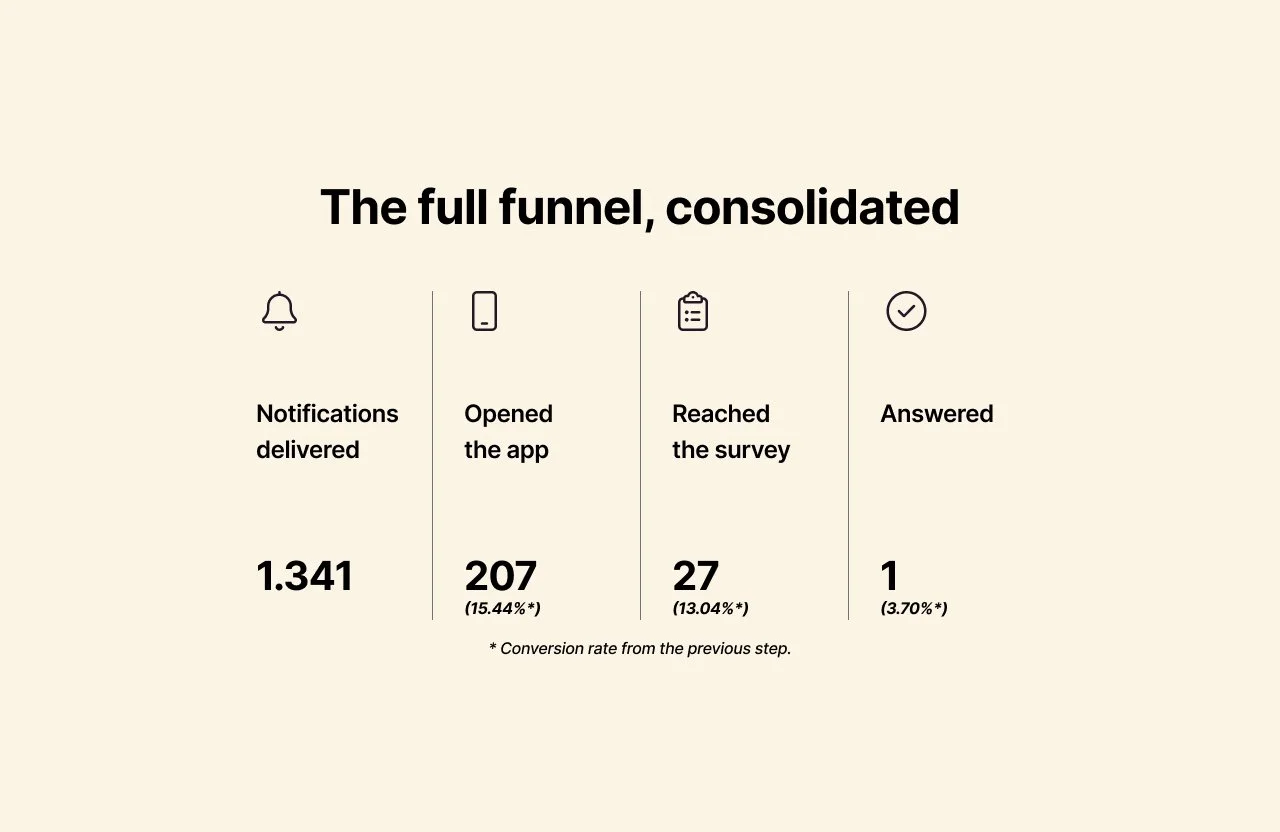
Two targets cleared. One answer.
One category carried the signal: Electronics did most of the work. It received 540 of the 1,341 notifications and produced 110 of the 207 app opens, 25 of the 27 survey visits and the only answer. Dental is the contrast worth noticing: almost the same reach, 488 notifications and a solid 13.52% open rate, but nobody went further. People were curious enough to tap, but a dental treatment isn’t something they think of insuring. Home and furniture brought the only other survey visits, 2 of them. Car opened well at 16%, but on just 50 notifications. Health and motorbike were too small to read anything into.
Curiosity isn’t intent: On paper, Experiment B passed: both targets were beaten. In practice, it answered a narrower question than the one we asked. Post-purchase insurance can work, but not as one generic message. It works where the purchase is a thing people are afraid to lose, like a new phone or a laptop, and where the offer speaks to that object. The last step taught me the most. Between 27 survey visits and 1 answer, the test couldn’t tell whether people didn’t want the insurance or were put off by a door that led nowhere. Both hypotheses stayed inconclusive, and that was an honest result, not a failed one.
OUTCOME
ONE FLOW. ONE PAYMENT.
Discovery, prototype and two live tests in four weeks, November 2022.
2 → 1
products on one screen, credit and insurance, with a single monthly payment
3 + 1
ready plans for every specific credit purpose, plus one you build yourself
3/4
checkout hypotheses validated with customers, in the store
1.341
Cofidis Pay customers reached in two days to test demand after purchase
The LAB handed over a tested checkout flow, a live read on post-purchase demand and four recommendations: earn trust in insurance with clear conditions, let the loan’s purpose pick the offer, reward bundling, and build post-purchase offers category by category.
04. WHAT I LEARNEDWHAT EXPERIMENTATION AT THE LAB TAUGHT ME, AND HOW I WORK DIFFERENTLY BECAUSE OF IT.
01. PUT THE BAR WHERE PEOPLE COMMIT.
Our post-purchase targets were about clicks, and we beat both. The step that would have shown real intent, from 27 survey visits to 1 answer, was the one the test couldn’t explain. A target on curiosity will almost always look good. I now put the main threshold where people commit something, and design the test so that “not interested” and “put off by the test” look different in the data.
02.
DISTRIBUTION CAN OUTWEIGH THE PRODUCT.
One push reached 1.341 customers in two days at no acquisition cost, and the checkout put the offer in front of people already buying from a brand they trusted. The insurance itself was close to a commodity, and Cofidis later launched with an insurer’s standard products. What Cofidis really brought was its customers and the moments it already shared with them. I now ask which channel a new product can ride before deciding what it should be, knowing the channel brings reach, not fit.
03.
START WITH THE PEOPLE WHO RUN THE PRODUCT.
This experiment lived inside products other teams owned. The workshop made the website and Cofidis Pay teams co-authors instead of gatekeepers, and that is what got us a prototype inside their flow and a push to their users within four weeks. When an experiment touches an existing product, I now begin with the people who run it, not with the screens.
05. WHERE IT STANDSTHE IDEA LEFT
THE LAB.
A year after the experiments, in November 2023, Cofidis signed a five-year exclusive agreement with Ageas to sell insurance outside credit, starting with home, car, life, pets, personal accident and travel. The go-to-market was built by a dedicated insurance team inside Cofidis, with consultants from McKinsey.
By then I had moved to the Homebanking team, where I led product design, so I can’t say how much the LAB’s work shaped that decision. I have since left Cofidis and don’t know where the offer stands today. What I do know is that the question we were asked in 2022, whether Cofidis could sell insurance inside the moments it already owned, became a business line.
None of it happened alone. Thank you to:
My LAB team at Cofidis Portugal, who turned a four-week timebox into two live experiments without cutting corners on the customer.
The website and Cofidis Pay teams, for opening their products to an experiment that wasn’t theirs, and for sketching it with us.
Every customer who stopped at our table, who gave up part of their day to tell us what they’d never pay for.
#StillDay1
This case reflects my personal experience as Product Designer at Cofidis Portugal LAB. It does not represent the views of Cofidis. Content has been simplified, and confidential information has been removed or anonymised.
